
Meaningful Name Combiner
Enter two names to create blends that keep recognizable pieces of each. Every result shows exactly which part came from which name, so the story behind your blend stays visible.
Click any result to copy it.
When you search for couple name combination with meaning, you are saying that sound alone is not enough. You want blends that carry story, cultural weight or symbolic roots while remaining readable and shareable. This guide shows a repeatable method: pick meaningful components, merge with purpose, and verify across languages and platforms.
Why meaning matters in couple name combinations
Meaning anchors a blended name to identity. A purely aesthetic mashup may look good on a wedding post but fails when you want the handle to represent family, a brand or long-term content. When meaning matters, you increase memorability and deepen emotional resonance. That said, meaning should not kill readability or searchability.
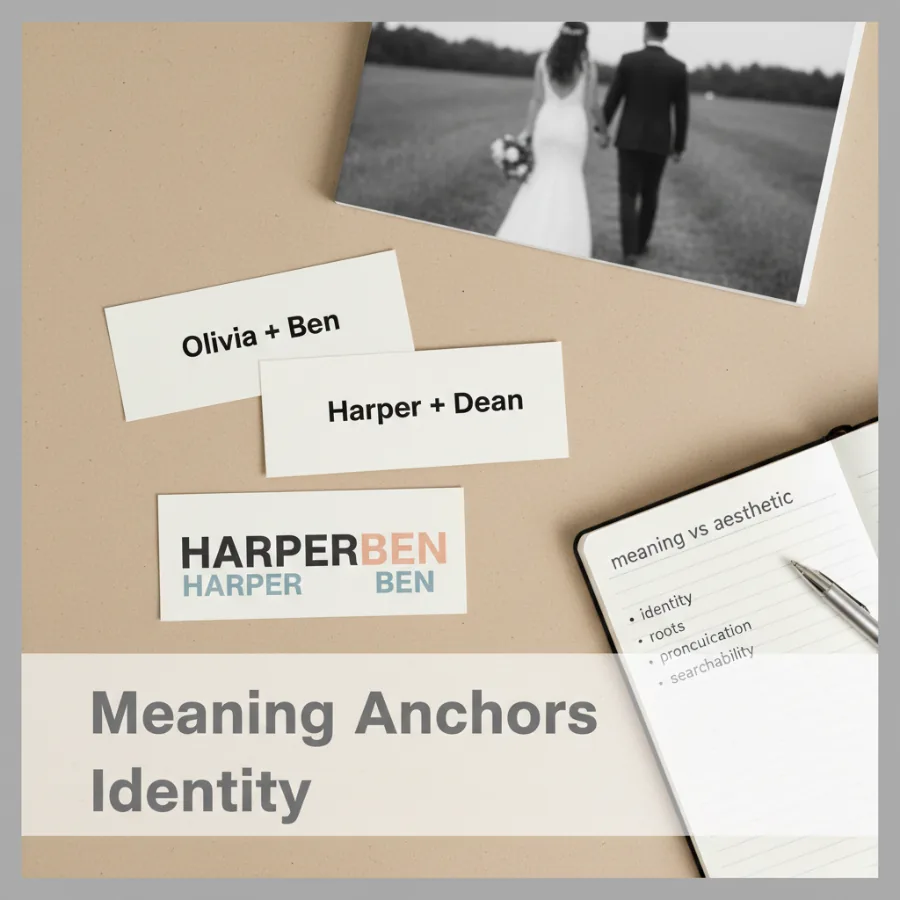
Emotional value vs aesthetic value
Emotional value comes from roots and associations. Aesthetic value comes from rhythm and length. Aim for blends that preserve at least one meaningful root from each name while maintaining natural pronunciation.
When meaning should trump uniqueness
If the handle will be used for family, heritage, or religious contexts, prioritize meaning. If the handle is for a short-term campaign, choose aesthetic variants instead.
Approaches to building meaningful blends
There are three practical approaches that consistently work: preserve key syllables, use meaningful initials or letters, and create story-based blends that reference a shared event or value.
1. Preserve key syllables that carry meaning
Many names contain morphemes or roots with known meanings. Identify the meaningful syllable in each name and prioritize keeping it.
Example: Aarav (meaning: peaceful) + Aisha (meaning: alive) → Aarisha. Here, the long “aa” sound preserves identity while the blended result suggests two positive roots combined.
2. Use shared initials or meaningful letters
Initial-based blends are subtle but effective when roots don’t combine cleanly. Using initials plus a meaning-bearing noun keeps clarity.
Example: R (Rohan) + A (Ananya) + word (home) → RAHome or RAnyaHome. This signals origin while adding a meaning anchor.
3. Story-based merges
When you have a shared memory, place, or value, embed it. This is useful for couples who want a narrative handle.
Example: If you met in Kyoto, consider including kyo or ki as a meaningful fragment: Sam + Riya → SamRiyaKyo or a shorter SamRiya with “Kyoto ’19” in the bio.
Step-by-step method
- List name components. Break each name into syllables and note meanings where known.
- Choose the priority. Decide if you want meaning-first, sound-first, or balanced.
- Apply 3 merge tests. Test (A) first+last, (B) overlapping letters, (C) initials + word.
- Read aloud test. Say the blend in a sentence. Look for pauses and false word breaks.
- Etymology check. Search the components’ meanings using two reputable sources (name dictionaries, cultural sites).
- Cross-language scan. Run a quick Google search for the blended word and check top results for unintended uses.
- Availability test. Check social handles and a domain if you plan to expand.
Examples — mix name for couple with meaning
Below are categorized examples that follow the method. For each, the explanation shows why the blend preserves meaning.
Preserve-root blends
Ravi (sun) + Kiran (ray) → Raviran (keeps solar root). Suitable for family or spiritual content.
Initials + meaning-word
S + M + “home” → SMHome or SMFamily. Keeps initials visible while adding a meaning anchor.
Story-based blends
Met in Paris: Tom + Lila → TomLilaPar or use TomLila and add “Paris” in bio for cleaner handle but preserved story in profile.
How to check the meaning of your new blend
Follow these checks before finalizing.
- Component lookup: Search each root’s meaning on two name-meaning sources.
- Full-blend search: Google the final blend in quotes and check first 10 results.
- Language risk scan: Check major languages you expect your audience to use (e.g., English, Spanish, Hindi, Arabic).
- Pronunciation test: Ask three people to read the handle aloud; note confusions.
Stylish couple name ideas with meaning
Style matters, but not at the cost of meaning. Keep these heuristics in mind:
- Prefer one soft vowel ending for flow.
- Avoid double hard consonant clusters across the merge.
- If the blend looks long, attach a neutral noun instead of numbers.
Balancing style, length and significance
Short, meaningful blends rank better for memory. If the meaningful fragment makes the handle long, compress one non-critical syllable or move the story to the bio.
FAQ
Can a single combined name reflect both people equally?
Yes, if both names contribute a meaningful fragment. When parity is impossible, prioritize meaning for the context the handle represents.
Should meaning or sound come first?
Meaning first for family/heritage contexts. Sound first for social or marketing contexts. If in doubt, strike a balance and document the blend’s origin in the bio.
How do I explain the combined name meaning to others?
Put a one-line origin in the bio: for example, “Aarisha = Aarav (peace) + Aisha (life).” That transparency improves connection and search relevance.
Hindi couple name combinations with meaning
Some of the most-searched couple blends come from Hindi-speaking couples who want the merged name to keep a real meaning, not just a nice sound. Here is how to build them.
Keep the meaningful root intact
Many Hindi names carry clear meanings in their first syllable: Aarav (peaceful), Aisha (alive), Ravi (sun), Kiran (ray), Prem (love), Asha (hope). When blending, protect that root syllable and build around it. Example: Aarav + Aisha keeps both roots: Aarisha, which reads as peace + life.
Respect vowel length
Hindi distinguishes short and long vowels, and blending often destroys that distinction. Aarav + Siya becomes Aasiya only if you keep the long “aa.” Write the blend in Devanagari and check it with a native speaker before finalizing; a blend that looks fine in Latin script can mispronounce in script.
Examples with meanings
- Raviran – Ravi (sun) + Kiran (ray). Keeps the solar meaning of both names.
- Premisha – Prem (love) + Aisha (alive). A living love; works as a handle or family name.
- Ashavi – Asha (hope) + Ravi (sun). Hope of the sun; short and brandable.
Meaningful blends FAQ
What is a good Hindi couple name combination?
A good Hindi couple blend keeps one meaningful root from each name and respects vowel length. Start with the combiner above, then verify the shortlisted blends in Devanagari and check their meanings with family elders before using them publicly.
How do I keep the meaning when blending two names?
Identify the meaningful syllable in each name first, then refuse to cut it during blending. If the meaningful parts do not merge cleanly, use initials plus a meaning word (for example, R + A + home becomes RAHome) instead of forcing a fusion that destroys both roots.
Can a blended name work for both a wedding hashtag and daily life?
Yes, if you choose a blend that is short and meaningful rather than joke-like. Pairs like Raviran work as a hashtag, a handle, and even a family label because the meaning carries them beyond the wedding. Test yours with the wedding hashtag generator too.